Choosing the best Pe Geomembrane in 2026 starts with the site, not the product brochure. A pond liner faces different demands from a mining containment cell or a landfill base. Heat, sunlight, chemicals, subgrade movement, and installation quality all affect long-term performance. Small details matter. A sharp stone beneath the liner can become a costly weak point.
A useful paraphrase of geosynthetics expert Dr. Robert M. Koerner’s published guidance is this: select a material for the conditions it must withstand, not its label alone. This article turns that principle into a practical checklist. It examines resin quality, thickness, tensile and puncture properties, stress-crack resistance, UV exposure, and seam testing. It also considers documentation, manufacturing consistency, and the installer’s experience. Ask for test data tied to the project’s actual conditions. Compare specifications carefully; a thicker sheet is not automatically the better choice. Nor does a familiar brand remove the need for verification.
The right decision balances engineering requirements, service life, installation constraints, and budget. Some projects have incomplete site data. That is uncomfortable, but worth acknowledging. Where uncertainty remains, get qualified technical advice before choosing a liner. This guide offers a clear starting point—not a substitute for project-specific design or independent review.
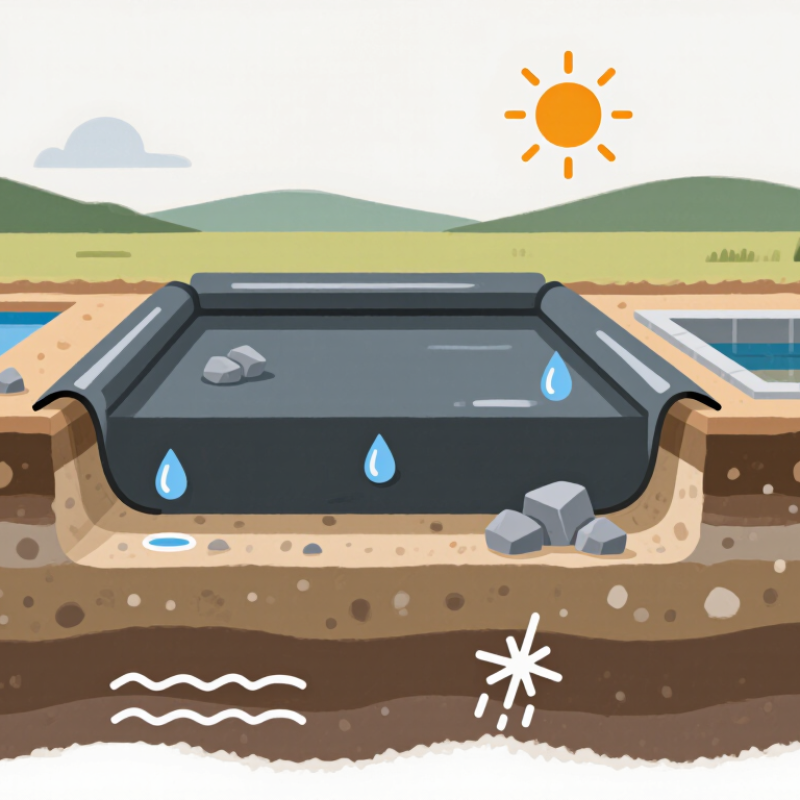
Before comparing PE geomembranes, define what the liner must contain and for how long. Record the liquid’s chemistry, concentration, temperature, and expected contact time. A material suitable for one process may not suit another. Specify the design life, allowable leakage risk, and whether the liner will remain exposed or be covered. Small details matter.
Then inspect the actual site, not just its drawings. Note slopes, drainage paths, groundwater, and areas where vehicles or equipment may cross. Walk the prepared subgrade and look for sharp stones, roots, soft spots, and uneven transitions. A few stones can create trouble. Ask how the ground may settle and whether the surface can be kept dry during installation. Wind, rain, and limited access can also affect panel placement and seam quality.
Use these requirements to discuss resin type, thickness, surface texture, and seam testing with a qualified designer or installer. For example, steep or covered slopes may call for different surface characteristics than a flat, exposed basin. Match the specification to the site’s real construction conditions, including available welding space and inspection access. Field observations are not always complete; revise assumptions when excavation reveals unexpected soil or water. A tidy plan can still miss something. That is worth checking.
Choosing PE geomembrane starts with the conditions it must handle, not a thickness chart alone. HDPE is relatively stiff and often chosen for chemical resistance and dimensional stability. LLDPE bends more easily around slopes, corners, and uneven subgrades. There is a trade-off. Textured surfaces can increase interface friction, while smooth sheets may suit other contact conditions.
Thickness options such as 1.0, 1.5, and 2.0 millimeters are common points of comparison, but none is automatically best. A thicker liner may offer greater puncture resistance, yet careful subgrade preparation still matters. Imagine a sharp stone beneath a liner: extra material helps, but it cannot replace removing the stone. Check tensile strength, puncture resistance, stress-crack resistance, and UV performance against the project design and supplier test data.
Installation details count. Small details matter. Seams, anchoring trenches, and daily temperature changes can affect field performance. I would not choose by polymer type or thickness alone; sometimes the site’s slope or subgrade tells a less convenient story. Review the expected exposure, contact surfaces, installation method, and quality-control plan together before specifying a sheet.
Compare PE geomembrane types, thicknesses, and properties. The ranges below are typical planning values, not universal requirements; confirm the project specification, site conditions, and applicable standards before selecting a liner.
HDPE is generally stiffer and offers strong chemical resistance, making it a common choice for containment. LLDPE is generally more flexible and can better accommodate uneven subgrades and settlement. Actual performance depends on resin, formulation, thickness, installation, and testing. Thickness alone does not determine suitability.
A PE geomembrane datasheet should show more than thickness and resin type. Compare its declared properties with the Geosynthetic Institute’s GRI-GM13 specification for HDPE geomembranes. For 1.5 mm smooth material, the specification sets tensile-strength minimums of 22 kN/m at yield and 40 kN/m at break, tested under ASTM D6693. These figures are useful benchmarks, not proof that every delivered roll meets them.
Check the test method, sample thickness, date, and laboratory on each report. Look for stress-crack testing under ASTM D5397 and seam testing under ASTM D6392, where relevant to the project. Small details matter. A certificate may cover a product family, but not confirm the exact production lot. Ask for traceable, lot-specific results and verify that the laboratory’s accreditation covers the tests shown. Compare the reported values with the project specification, rather than choosing the highest number on a brochure. I would still treat a clean datasheet cautiously: real installation conditions and field seams can expose weaknesses that factory samples do not.
| Selection Dimension | What to Check | Relevant Standard or Evidence | How to Evaluate the Data |
|---|---|---|---|
| Resin type and application | Confirm whether the liner is HDPE or LLDPE and whether its flexibility, chemical compatibility, and installation requirements suit the project. | Product technical data sheet; project-specific chemical compatibility assessment; applicable geomembrane specification. | Do not treat HDPE and LLDPE as interchangeable. Select based on site conditions, subgrade movement, chemical exposure, and design requirements. |
| Thickness and profile | Check nominal thickness, measured thickness, thickness tolerance, and whether the surface is smooth or textured. | ASTM D5199 for measuring smooth geomembrane thickness; ASTM D5994 for measuring the thickness of textured geomembranes. | Compare test results with the specified nominal thickness and project acceptance criteria. There is no single thickness suitable for every application. |
| Core material property specification | For HDPE, check whether the product is evaluated against a recognized specification for key properties such as thickness, tensile behavior, tear, puncture, and durability. | GRI-GM13, the Geosynthetic Institute’s specification for HDPE geomembranes; confirm the applicable revision and project requirements. | Use the specification as a baseline, not as a substitute for project design. Verify that the listed product type, thickness, and test methods match the purchase specification. |
| Tensile properties | Review yield strength, break strength, and elongation, including the specimen direction and test method. | ASTM D6693, tensile properties of nonreinforced polyethylene and flexible polypropylene geomembranes. | Compare results with the applicable specification and design needs. Check both machine and cross-machine directions where required. |
| Tear and puncture resistance | Check tear resistance and puncture resistance for the specified material and thickness. | ASTM D1004 for initial tear resistance; ASTM D4833 for index puncture resistance. | Use these results to compare products under the same test conditions. They are index tests and do not, by themselves, predict field performance. |
| Density and polymer identification | Review density data and confirm that the declared polymer type is consistent with the product specification. | ASTM D1505 for density of plastics by the density-gradient technique; product technical data sheet. | Check that values meet the applicable material specification. Density alone does not establish overall liner quality or chemical resistance. |
| Carbon black content and dispersion | For black geomembranes, review carbon black content and dispersion test results. | ASTM D4218 or ASTM D1603 for carbon black content; ASTM D5596 for carbon black dispersion in polyolefin geomembranes. | Confirm that results meet the applicable specification and that dispersion is reported using the method’s classification system. |
| Stress-crack resistance | Review test results for resistance to stress cracking, especially where the design involves sustained tensile stress or demanding installation conditions. | ASTM D5397, notched constant tensile load test for evaluating stress-crack resistance of polyethylene geomembranes. | Compare the reported test duration and outcome with the applicable specification. Do not compare results from different methods as if they were equivalent. |
| Oxidative durability | Check oxidative induction time (OIT) or high-pressure OIT (HP-OIT), including initial values and any required retained values after aging. | ASTM D3895 for OIT; ASTM D5885 for HP-OIT. | Use the method and acceptance limits named in the project specification. OIT results are indicators of antioxidant response, not a direct service-life prediction. |
| Ultraviolet exposure resistance | For exposed installations, check the specified UV-aging test method and the required post-exposure property retention. | ASTM D7238 for exposure of geomembranes to laboratory weathering; relevant post-exposure OIT or HP-OIT testing when specified. | Confirm exposure conditions, duration, and acceptance criteria in the governing specification. Do not assume buried and continuously exposed applications have identical requirements. |
| Batch traceability and test reports | Request lot-specific quality-control results, production lot identification, test dates, methods, units, and acceptance limits. | Manufacturer’s quality-control records; independent laboratory reports where required; project quality assurance and construction quality assurance plans. | Make sure the reports identify the actual supplied lot and product specification. Generic brochures are not a substitute for lot-specific records. |
| Laboratory competence | Check whether the testing laboratory is competent for the relevant methods and whether its accreditation scope covers those tests. | ISO/IEC 17025 accreditation and the laboratory’s published scope of accreditation. | Accreditation applies to the listed laboratory activities and methods; verify the scope rather than relying on the accreditation logo alone. |
| Quality management certification | Review the supplier’s quality management system certificate, issuing body, validity period, and certified scope. | ISO 9001 quality management system certification. | ISO 9001 is a management-system certification, not a product-performance certification. Continue to check the geomembrane’s test data and project compliance. |
| Potable-water or regulated-use approvals | If the liner will contact drinking water or serve another regulated use, check the exact approval required for that application and jurisdiction. | Applicable local regulations and, where required, a relevant health-effects certification such as NSF/ANSI/CAN 61. | Verify that the approval covers the specific material, intended use, and conditions of service. Do not assume a general geomembrane specification grants potable-water approval. |
| Project fit and installation requirements | Confirm chemical compatibility, subgrade condition, seam design, exposure, slope, temperature, and construction quality assurance requirements. | Project design documents; compatibility testing where needed; approved installation and seaming procedures. | The best choice is the product that meets the project’s design and regulatory requirements and can be installed and verified under the site’s conditions. |
Important: Standards and acceptance limits can vary by product type, thickness, application, and specification revision. Confirm the governing documents for the project and review complete, traceable test reports before purchase.
A PE geomembrane is only as dependable as its material consistency and installation. Ask the manufacturer for current technical data, thickness tolerances, resin information, and quality-control records for the production lot. Check that reported tensile, puncture, and environmental resistance values match the project specification. A glossy datasheet alone is not proof. Small details matter. Confirm that the sheet’s surface, thickness, and seam method suit the site conditions, rather than relying on a generic product description. If documents are unclear or values cannot be traced to testing, pause and ask for clarification.
Installation requirements deserve equal attention. The subgrade should be smooth and firm, without sharp stones, standing water, or sudden changes in slope. Confirm that the selected installer has experience with the specific sheet type and can document welding procedures, equipment checks, and seam testing. Weather matters: wind can lift loose panels, while damp or dirty surfaces can compromise welds. A trial seam can reveal problems before large areas are covered. Keep records of panel locations, seam tests, repairs, and site conditions. Plans are not always followed perfectly; I would inspect actual field practices, especially where the schedule is tight.
Choosing a PE geomembrane means weighing purchase price against service life and upkeep. A low quote may omit subgrade preparation, seam testing, or protective geotextiles. Those omissions matter when a sharp stone sits beneath a liner or a weld needs repair. Compare the full installed system, not just the price per square metre.
The Geosynthetic Institute’s GRI-GM13 specification sets a 2.0–3.0% carbon black range by weight for HDPE geomembranes. Carbon black helps protect exposed material from ultraviolet degradation, but it cannot guarantee a particular lifespan. Not a lifespan promise. Ask suppliers for current test results, thickness measurements, and documentation showing the proposed sheet meets the project specification.
Then estimate maintenance realistically. Include scheduled inspections, seam checks, drainage upkeep, and access for repairs. A buried liner and an exposed pond slope face different conditions, so their inspection plans should differ too. I would not automatically choose the thickest sheet; that shortcut can increase initial cost without solving weak subgrade or poor welding. Still, life-cycle estimates are only estimates. Record the assumptions, then compare options using the same service period and maintenance scope.
Check thickness, resin type, declared properties, test methods, sample thickness, test date, and laboratory details. A tidy sheet is not enough.
The cited specification sets minimums of 22 kN/m at yield and 40 kN/m at break. Treat them as benchmarks, not delivery guarantees.
A certificate may cover a product family, not the rolls arriving on site. Match the results to the production lot.
Review stress-crack and seam test results where relevant. Confirm the laboratory is accredited for the listed tests. Small details matter.
No. Factory samples may not reflect field seams, uneven ground, or a sharp stone beneath the liner. I may be too cautious, but I would check.
Compare the installed system, not just the price per square metre. Include subgrade preparation, seam testing, protective geotextiles, and repairs.
The cited HDPE specification gives a 2.0–3.0% range by weight. Carbon black helps resist ultraviolet degradation, but it cannot promise a fixed service life.
An exposed pond slope and a buried liner face different conditions. Plan inspections, seam checks, drainage upkeep, and repair access accordingly. Estimates can miss things.
Choosing the best Pe Geomembrane in 2026 starts with understanding the project’s purpose and site conditions. Consider what the liner will contain, the ground beneath it, exposure to sunlight and chemicals, temperature changes, and expected operating conditions. Compare available polyethylene geomembrane types and thicknesses according to the flexibility, strength, and resistance the project requires rather than selecting solely by price.
Before making a decision, review relevant performance standards, test data, and certifications, and assess the manufacturer’s quality controls and installation guidance. Proper handling, seaming, and installation are essential to achieving reliable performance. Finally, weigh the initial purchase and installation costs against expected service life and future maintenance needs. A well-matched liner can help reduce repairs and provide dependable containment over time, while a careful evaluation helps avoid paying for properties the project does not need.

Changhong