China’s plastic manufacturing sector includes many capable suppliers of Plastic Grate Panel products. This guide introduces ten manufacturers for buyers comparing quality, customization, and export reliability. It is designed for engineers, distributors, contractors, and industrial procurement teams.
The evaluation focuses on practical evidence rather than attractive brochures. Key factors include resin selection, molding accuracy, panel thickness, load capacity, drainage performance, and surface grip. Buyers should also review UV resistance, chemical compatibility, fire performance, and operating temperature. Factory experience matters. A supplier producing drainage panels for years may understand tooling problems better than a new trading company.
Certifications help, but they do not tell the entire story. Request test reports, production photos, sample panels, and recent project references. Check whether the stated dimensions match the delivered products. Small differences can affect installation. Ask about mold ownership, minimum order quantities, packaging, lead times, and replacement support. These details often reveal a manufacturer’s real service capability.
The final selection should depend on application conditions. A lightweight panel for a walkway may not suit a chemical plant. No ranking is permanent. Company capacity, materials, and export performance can change. Some online information may also be incomplete or outdated. Therefore, this list should support further verification, not replace it. Direct communication, independent inspection, and sample testing remain sensible steps before signing a purchase agreement. The following manufacturers are presented as potential partners, with attention to technical credibility, manufacturing consistency, and responsible business practices.
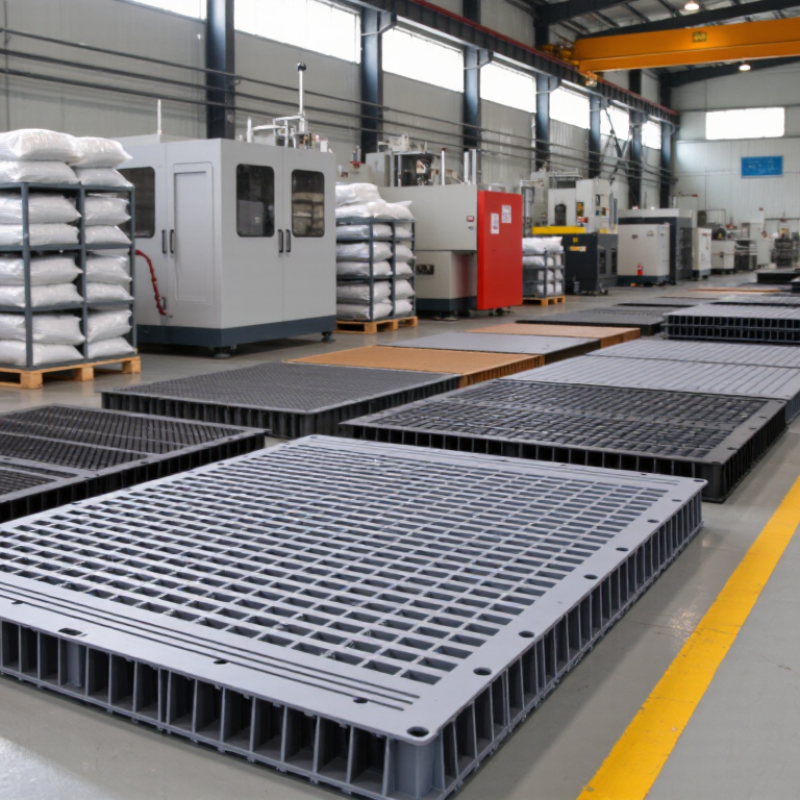
A plastic grate panel is a rigid, open-grid sheet made from engineered plastic. It creates a raised, stable surface while allowing water, air, and light to pass through. Common materials include polypropylene, polyethylene, and reinforced PVC. Each material behaves differently under heat, chemicals, and repeated loading.
In practical installations, these panels cover drainage channels, service walkways, greenhouse floors, and wet processing areas. Their square openings reduce standing water around boots and equipment. A textured surface can also improve traction, although mud may still collect in deep patterns. Panels are usually joined with clips, bolts, or interlocking edges. Accurate measurements matter because a small gap can become a trip point.
When comparing China’s top ten plastic grate panel manufacturers, buyers should inspect load ratings, UV resistance, chemical compatibility, and dimensional stability. Request test reports and sample pieces before placing a large order. I have found that a panel feeling rigid by hand does not prove long-term performance. Support spacing, temperature changes, and installation quality can alter the result. That detail is easy to overlook. A reliable supplier should explain resin type, production tolerances, drainage design, and replacement procedures. For food, agricultural, or industrial areas, cleanability and slip resistance deserve equal attention. Low cost may look attractive, but weak clips or uneven edges can create maintenance problems later.
China’s plastic grate panel manufacturers typically begin with polypropylene, polyethylene, or reinforced resin pellets. Material selection depends on drainage, chemical exposure, load requirements, and installation temperature. Before production, technicians dry and blend the pellets with pigments, stabilizers, and reinforcing additives. Small recipe changes can affect flexibility and surface color.
The mixture enters an injection molding or compression molding machine. Heat softens the pellets, while controlled pressure fills a metal mold with ribs, openings, and connecting edges. After cooling, workers remove the panel and trim excess plastic. Experienced inspectors check dimensions, weight, flatness, and hole consistency. Some facilities also test load resistance and chemical durability. However, not every supplier uses identical testing methods, so buyers should request clear inspection records. A glossy surface alone proves little.
Tips: Ask for material specifications, mold drawings, and sample panels before ordering. Check whether the panel remains stable after repeated loading, sunlight exposure, and water contact. Measure the actual opening size, because small differences can affect drainage. I would also inspect several production batches, not just one approved sample. Manufacturing is usually consistent, but occasional warping or color variation still deserves attention.
Comparative overview of representative Chinese manufacturing profiles and commonly used production specifications for plastic grate panels. The figures below describe typical industry ranges rather than company-specific claims.
| Rank | Manufacturer Profile | Primary Material | Manufacturing Method | Common Panel Size | Typical Thickness | Typical Mesh Opening | Typical Application | Quality-Control Focus |
|---|---|---|---|---|---|---|---|---|
| 1 | Profile A Industrial |
Glass-fiber-reinforced polypropylene (PP) | Injection molding with reinforced ribs | 1,000 × 500 mm | 25–35 mm | 25–40 mm square | Factory walkways and platforms | Dimensional accuracy, rib filling, warpage |
| 2 | Profile B Drainage |
UV-stabilized high-density polyethylene (HDPE) | Compression molding or thermoforming | 1,000 × 500 mm | 20–30 mm | 20–30 mm square | Drainage channels and wet areas | UV resistance, impact strength, drainage rate |
| 3 | Profile C Corrosion-Resistant |
Fiberglass-reinforced plastic (FRP) | Pultrusion with molded grating assembly | 3,660 × 1,220 mm | 25–38 mm | 38 × 38 mm | Chemical plants and wastewater facilities | Resin content, glass-fiber alignment, load performance |
| 4 | Profile D Lightweight |
Recycled polypropylene (rPP) | Injection molding using recycled pellets | 600 × 400 mm | 18–25 mm | 15–25 mm square | Temporary floors and service areas | Recycled-content consistency, surface defects |
| 5 | Profile E Food & Hygiene |
Food-contact-grade polypropylene | Precision injection molding | 1,200 × 600 mm | 20–30 mm | 20–35 mm square | Food-processing and cold-storage floors | Cleanability, resin traceability, smooth edges |
| 6 | Profile F Heavy Duty |
Mineral-filled polypropylene | High-pressure injection molding | 1,000 × 500 mm | 30–50 mm | 30–50 mm square | Heavy equipment and loading zones | Static load, impact resistance, support spacing |
| 7 | Profile G Aquaculture |
UV-stabilized HDPE | Extrusion with modular interlocking design | 600 × 600 mm | 25–35 mm | 25–50 mm square | Fish farms and aquatic facilities | Buoyancy, slip resistance, salt-water durability |
| 8 | Profile H Ventilation |
Flame-retardant ABS or modified PP | Injection molding with ventilation channels | 500 × 500 mm | 15–25 mm | 15–30 mm square | Equipment rooms and ventilation floors | Flammability behavior, dimensional stability |
| 9 | Profile I Landscape |
UV-resistant recycled HDPE | Compression molding with textured surface | 1,000 × 500 mm | 20–30 mm | 20–40 mm square | Gardens, balconies, and exterior decks | Color stability, slip resistance, drainage |
| 10 | Profile J Modular |
Polypropylene copolymer (PP-C) | Injection molding with snap-fit connectors | 300 × 300 mm modules | 18–30 mm | 15–35 mm square | Workshops, showers, and removable flooring | Connector strength, assembly tolerance, edge fit |
| Typical production sequence in China: material selection and drying → color and additive blending → mold design and tooling → injection, compression, extrusion, or pultrusion → trimming and surface finishing → dimensional, load, impact, slip, UV, and chemical-resistance testing → packaging and shipment. | ||||||||
A top plastic grate panel manufacturer proves performance beyond a polished catalog.
The supplier should disclose resin type, reinforcement content, load ratings, and test methods. Independent testing for flexural strength, slip resistance, fire behavior, and chemical exposure adds credibility. ISO 9001 certification helps, but it cannot replace factory evidence.
On a real project, examine panel edges, molded ribs, fixing points, and drainage openings. Uneven ribs can create trip hazards. Poorly controlled dimensions may leave gaps during installation.
A reliable manufacturer maintains batch records, inspection photos, and traceable raw materials. It should also provide installation guidance for cutting, support spacing, and fastener selection.
Details matter. Not always.
Sustainability now affects purchasing decisions.
The OECD Global Plastics Outlook reported that only 9% of plastic waste was ultimately recycled in 2019. Therefore, a responsible supplier should explain recycled content, expected service life, repair options, and end-of-life handling. PlasticsEurope reported global plastics production reached 413.8 million tonnes in 2023, increasing pressure to reduce material waste. A top supplier responds with measurable data, not vague green language.
Cost still matters, yet the cheapest panel may fail under sunlight, chemicals, or repeated loading. Ask for accelerated weathering results and documented field experience. A manufacturer with engineering support can adjust panel thickness, resin formulation, and surface texture for the site.
Some suppliers promise too much. That deserves careful questioning.
China’s top 10 plastic grate panel manufacturers are often judged by more than production volume. Practical experience shows that material consistency matters most during installation. Panels should resist moisture, ultraviolet exposure, oils, and common cleaning chemicals. Different projects may require polypropylene, PVC, or reinforced composite structures.
A reliable manufacturer usually offers clear drawings, stable dimensions, and traceable quality records. Check panel thickness, opening size, surface texture, and load performance before ordering. Factory testing should include weight checks, impact evaluation, and long-term weather exposure. Samples can reveal rough edges or uneven molding.
Manufacturers serving industrial floors often provide custom cutting, anti-slip finishes, and drainage layouts. Experienced teams can suggest suitable panel spacing for workshops, walkways, platforms, and water-treatment areas. However, a polished catalog does not prove dependable production. I would still inspect batch samples and confirm packaging protection before shipment. Some suppliers communicate well but respond slowly when defects appear. Others provide strong technical data but limited customization. This gap deserves careful attention during comparison. Pricing should be reviewed with tooling, transport, replacement parts, and inspection costs included. A thoughtful selection process creates a more realistic view of China’s leading plastic grate panel manufacturers.
Choosing among China’s top 10 plastic grate panel manufacturers requires more than comparing prices. Start with the panel’s actual use: drainage channels, walkways, platforms, or industrial flooring. Confirm load ratings, resin type, panel thickness, surface texture, and opening size. A supplier should provide current test reports, material data, and clear tolerances. Ask whether those results apply to your exact model, not a similar sample.
Request samples before approving a large order. Inspect cut edges, flatness, color consistency, and fit with your support frame. Try a simple load test using the intended span and weight. It will not replace laboratory testing, but it can reveal weak ribs or poor molding. Factory verification also matters. Review production equipment, mold condition, inspection records, and packaging methods through a live video call or independent audit. Some factories look impressive online. The shipment may tell another story.
Reliable communication is practical, not decorative. Your manufacturer should answer technical questions directly and confirm drawings, tolerances, labeling, lead time, and replacement procedures in writing. Check export experience and documentation before paying a deposit. A very low quotation may hide thin panels, unstable raw materials, or expensive tooling changes. I would also compare total landed cost, including freight, duties, molds, and rejected pieces. My judgment can be wrong when specifications are incomplete, so keep a written approval sample and define acceptance criteria before production.
This buyer evaluation framework emphasizes the factors that most directly affect project performance: product quality, load capacity, corrosion resistance, customization capability, compliance documentation, delivery reliability, and after-sales support. Buyers can adjust the weighting to match their application, environment, and technical requirements.
Common materials include polypropylene, polyethylene, PVC, and reinforced resin. Material choice depends on moisture, chemicals, weight, and installation temperature.
Pellets are dried, blended with pigments and additives, then heated. Injection or compression molding forms ribs, openings, and connecting edges.
Inspectors usually check dimensions, weight, flatness, and opening consistency. Some facilities also test load resistance, impact strength, and chemical durability.
Testing methods can differ between suppliers. Clear records show how panels were checked, though records alone may not reveal every defect.
Check thickness, hole size, surface texture, flatness, and rough edges. Measure several panels, not just one approved sample.
Suitable panels can tolerate sunlight, water, moisture, oils, and common cleaning chemicals. Buyers should confirm repeated exposure performance through test data.
They may suit workshops, walkways, platforms, drainage areas, and water-treatment spaces. The required opening size depends on drainage needs and foot traffic.
Consider tooling, transport, inspection, packaging, and replacement costs. A low unit price can become expensive after defects or damaged shipments.
Occasional warping, color variation, uneven molding, and weak packaging can occur. Small changes matter. I would inspect multiple production batches before ordering.
This guide explores what a Plastic Grate Panel is, how it supports drainage, ventilation, flooring, screening, and other practical applications, and why plastic is valued for its light weight, corrosion resistance, insulation, and easy maintenance. It also explains how these panels are produced in China through material selection, molding, reinforcement, surface treatment, quality inspection, and customized processing. Understanding the manufacturing process helps buyers evaluate product strength, dimensional accuracy, load capacity, safety, and service life.
The article presents a carefully organized overview of China’s top 10 Plastic Grate Panel manufacturers without focusing on brand promotion. It compares suppliers according to production experience, technical capability, quality management, customization options, delivery reliability, communication, and after-sales support. Finally, it provides practical advice for choosing the right Chinese manufacturer, including reviewing samples, confirming technical specifications, checking certifications, discussing packaging and lead times, and selecting a supplier that can consistently meet the project’s performance and budget requirements.

Changhong