Choosing the China Best Drain Tile Plastic Supplier for Global Buyers requires more than comparing prices. Buyers must examine material quality, production experience, testing records, and export communication. Drain Tile Plastic products may look similar, yet their performance can differ under soil pressure, freezing temperatures, and heavy rainfall.
A reliable supplier should explain resin grades, pipe diameters, wall thickness, perforation patterns, and filter-fabric options clearly. Factory visits, sample checks, and independent testing can reveal details that brochures often miss. Ask for production photos, quality-control procedures, and recent project references. Small details matter. A clean extrusion line and consistent perforations often indicate disciplined manufacturing.
Packaging also deserves attention. Strong bundles, protected edges, and moisture-resistant wrapping help prevent damage during long-distance shipping. The supplier should provide accurate dimensions, loading plans, and practical after-sales support. Experience with different markets is valuable, but it does not replace evidence. Certifications should be verified, not simply displayed.
No supplier is perfect. Even an experienced factory may face color variation, delayed communication, or occasional dimensional errors. A serious buyer should discuss corrective actions before placing a large order. The best partnership develops through samples, clear specifications, inspections, and honest feedback.
This guide explores how global buyers can assess Chinese manufacturers, compare Drain Tile Plastic solutions, and reduce purchasing risks. It focuses on usable evidence rather than attractive claims. Performance in real drainage projects remains the strongest test.
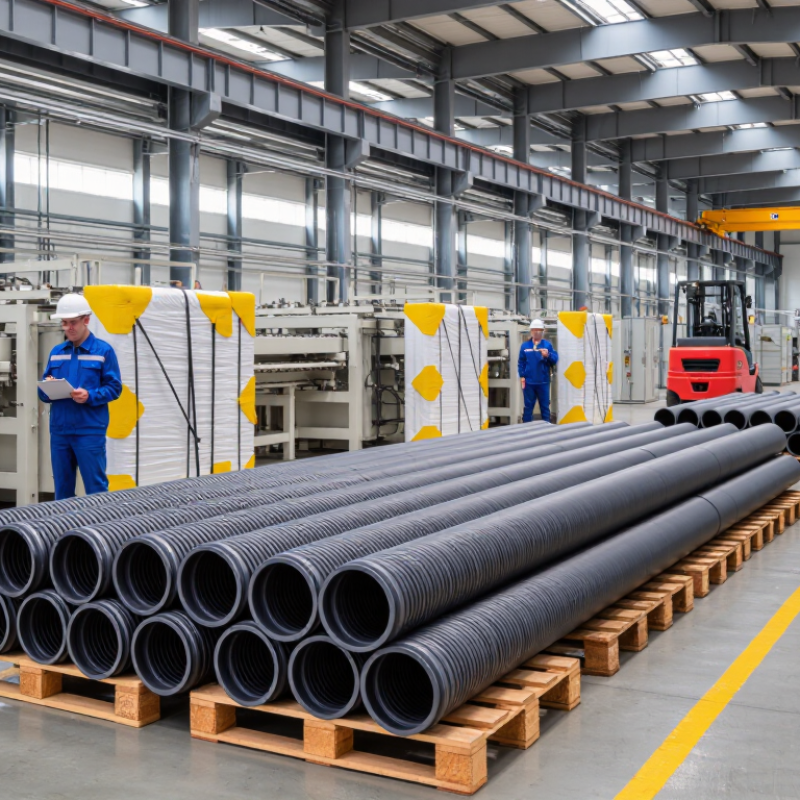
Plastic drain tile is a perforated pipe that collects and redirects excess water below ground. It protects foundations, fields, roads, and landscaped areas from prolonged saturation. HDPE drain tile is flexible, impact-resistant, and suitable for uneven trenches or soil movement. PVC drain tile is more rigid and maintains a straight route, which helps in precise drainage layouts. Both materials can perform well when their diameter, wall strength, perforation pattern, and joint design match the project.
Global buyers should examine soil pressure, temperature changes, burial depth, and local installation practices. A supplier in China may offer several pipe structures, but low price alone proves little. Request product samples, technical data, dimensional records, and quality inspection documents. I have seen drainage failures caused by poor fabric wrapping, crushed sections, and mismatched connectors. The pipe was not always the main problem. Sometimes, the trench design was.
Tips: Use a clean gravel layer around the pipe. Add suitable filter fabric where fine soil may enter the openings. Check the pipe’s compression strength before deep burial. Confirm whether the design needs single-wall or dual-wall construction. A small field trial can reveal weaknesses early. Specifications can look perfect on paper, yet installation conditions may disagree. Watch water flow after heavy rain, not only during a dry inspection.
| Evaluation Dimension | HDPE Drain Tile | PVC Drain Tile | Practical Buyer Consideration |
|---|---|---|---|
| Basic definition | Perforated or non-perforated corrugated pipe made from high-density polyethylene for collecting or conveying subsurface water. | Perforated or non-perforated smooth-wall or structured-wall pipe made from polyvinyl chloride for drainage systems. | Confirm whether the project needs a flexible corrugated pipe, rigid smooth-wall pipe, or a structured-wall design. |
| Typical material density | Approximately 0.94–0.97 g/cm³, depending on grade and additives. | Approximately 1.30–1.45 g/cm³, depending on formulation and reinforcement. | Density affects handling weight, transport cost, and installation effort; actual product mass should be checked from the technical datasheet. |
| Flexibility | High flexibility; suitable for curved alignments and ground movement when properly installed. | Generally more rigid than HDPE, especially in smooth-wall pipe configurations. | Flexible pipe can reduce the number of bends and fittings, while rigid pipe may provide more predictable alignment. |
| Corrosion and chemical resistance | Strong resistance to many salts, dilute acids, alkalis, and moisture; compatibility depends on chemical concentration and temperature. | Good resistance to many aqueous chemicals and salts; certain solvents and high temperatures may affect performance. | Review a chemical-resistance chart when drainage contains industrial chemicals, hydrocarbons, or unusual contaminants. |
| Temperature considerations | Commonly selected for cold and moderate-temperature drainage; sustained high temperatures can reduce stiffness and service life. | Suitable for many ambient drainage applications; prolonged elevated temperatures may reduce pressure and structural performance. | Use the manufacturer's allowable temperature and load data rather than relying only on material names. |
| Common nominal sizes | Small agricultural and landscape products commonly range from about 75 mm to 160 mm; larger sizes are also available. | Drainage products are commonly offered from about 100 mm upward, with larger diameters used for commercial and infrastructure work. | Available sizes vary by market and standard; specify inside diameter, outside diameter, or nominal size clearly. |
| Perforation options | Perforations may be arranged around part or all of the circumference; slot dimensions and open area vary by product. | Perforated designs are available with specified slot patterns and open areas for groundwater collection. | Select perforated pipe for collection and solid pipe for conveyance, unless the system design states otherwise. |
| Hydraulic behavior | Corrugations improve flexibility but can increase internal hydraulic roughness compared with smooth-wall pipe. | Smooth-wall PVC generally provides lower flow resistance than corrugated pipe of similar internal diameter. | Compare actual inside diameter, Manning's roughness assumption, slope, and design flow rate. |
| Installation method | Usually installed in a graded trench with suitable granular or screened backfill; bedding and compaction control performance. | Requires accurate alignment, suitable bedding, and correctly assembled joints; solvent-cement or gasketed systems depend on design. | For flexible pipe, soil-structure interaction and side support are especially important. |
| Typical applications | Foundation drains, French drains, agricultural field drainage, sports fields, landscaping, road subdrains, and stormwater collection. | Foundation drainage, gravity sewer and stormwater systems, building site drainage, road drainage, and industrial conveyance where compatible. | The correct choice depends on soil conditions, burial depth, load, hydraulic capacity, joint design, and local regulations. |
| Load performance | Performance depends on profile, wall construction, pipe stiffness, trench width, embedment, cover depth, and traffic loading. | Performance depends on wall thickness or profile, stiffness class, bedding, embedment, cover depth, and external loading. | Do not compare materials by resin name alone; request certified stiffness, deflection, and installation data. |
| Connection options | Couplers, snap connections, gasketed joints, and welded joints may be used depending on pipe design. | Gasketed bell-and-spigot joints, solvent-welded joints, mechanical couplings, or approved transition fittings may be used. | Check joint watertightness, compatibility with fittings, and whether the system is intended for infiltration or conveyance. |
| Relevant reference standards | Examples include ASTM F405, ASTM F667, ASTM D3350, and applicable EN or ISO standards, depending on product type and market. | Examples include ASTM D1784, ASTM F679, ASTM F949, EN 1401, EN 13476, and applicable local standards, depending on product type. | Standards are product-specific. Verify the exact edition, scope, testing requirements, and acceptance rules in the destination country. |
| How global buyers should evaluate suppliers | Request resin specification, recycled-content declaration, wall profile, perforation details, dimensional tolerances, packaging, and test reports. | Request compound classification, wall thickness, stiffness or pressure rating, joint details, dimensional tolerances, packaging, and test reports. | Compare technical compliance, quality-control records, production capacity, export packaging, lead time, and after-sales documentation rather than price alone. |
| Best-fit selection guide | Often preferred where flexibility, low handling weight, ground movement tolerance, and corrosion resistance are priorities. | Often preferred where rigid alignment, smooth hydraulic surfaces, established joint systems, and dimensional stability are priorities. | Final selection should be based on a project-specific hydraulic, structural, geotechnical, and regulatory assessment. |
Note: Values and application descriptions are general industry ranges and guidance. Exact performance depends on product design, installation quality, soil conditions, operating temperature, loading, and the applicable national standard.
Visit active extrusion lines during normal working hours. Check shift records, maintenance logs, and recent production schedules. Compare listed lines with operating lines. A factory may have ten lines but run only six.
Check raw material storage, batch labels, and resin purchasing records. Inspect finished tiles for warped edges, blocked channels, uneven thickness, and rough cuts. Small defects can delay installation.
Request samples from several production batches. Do not accept only hand-selected pieces. Measure dimensions with calipers and record each result. Keep sample codes for later comparison.
Test drainage flow, compressive strength, impact resistance, and UV performance. Match testing requirements to the project conditions. Outdoor use deserves careful UV review. Looks can mislead.
Confirm sample codes, test dates, laboratory identity, and product specifications. Check whether the report matches the supplied product. For higher-risk orders, send sealed samples to an independent laboratory. Supplier documents are helpful, but not final proof.
Ask for material declarations, safety information, and traceability procedures. Review records for handling nonconforming products. Confirm packaging, labels, and technical documents match the destination market. Details matter.
Ask whether a trial order of 500 or 1,000 pieces is possible. Confirm separate MOQs for colors, diameters, and connector designs. Compare identical plastic grades, wall thicknesses, perforation patterns, and packaging methods. A low price may hide tooling or transport costs.
Divide lead time into tooling, production, inspection, and shipping preparation. Request milestone dates in writing. Check who handles customs documents, damage claims, unloading, and destination charges. A short promise needs evidence. I once missed port storage fees.
Choosing the right Drain Tile Plastic supplier requires more than comparing product prices. Buyers should first understand the differences between HDPE and PVC pipes, their typical applications, and how diameters from 100 to 200 mm support agricultural, residential, and infrastructure drainage needs. Performance also depends on SN4 or SN8 stiffness ratings, installation conditions, soil pressure, and expected service life. Relevant quality references may include ASTM F405, ASTM F667, ISO 9001, and ISO 9969, but buyers should confirm which standards apply to their specific project and destination market.
A reliable supplier should provide clear technical specifications, production capacity, quality-control procedures, test reports, factory information, and compliance documentation. Global buyers should also compare minimum order quantities, sampling policies, production lead times, packaging, shipping options, payment terms, and Incoterms. A balanced evaluation of durability, testing transparency, communication, total landed cost, and delivery reliability can help buyers select a suitable Chinese supplier for long-term drainage projects.

 Changhong